Transactional Emulator
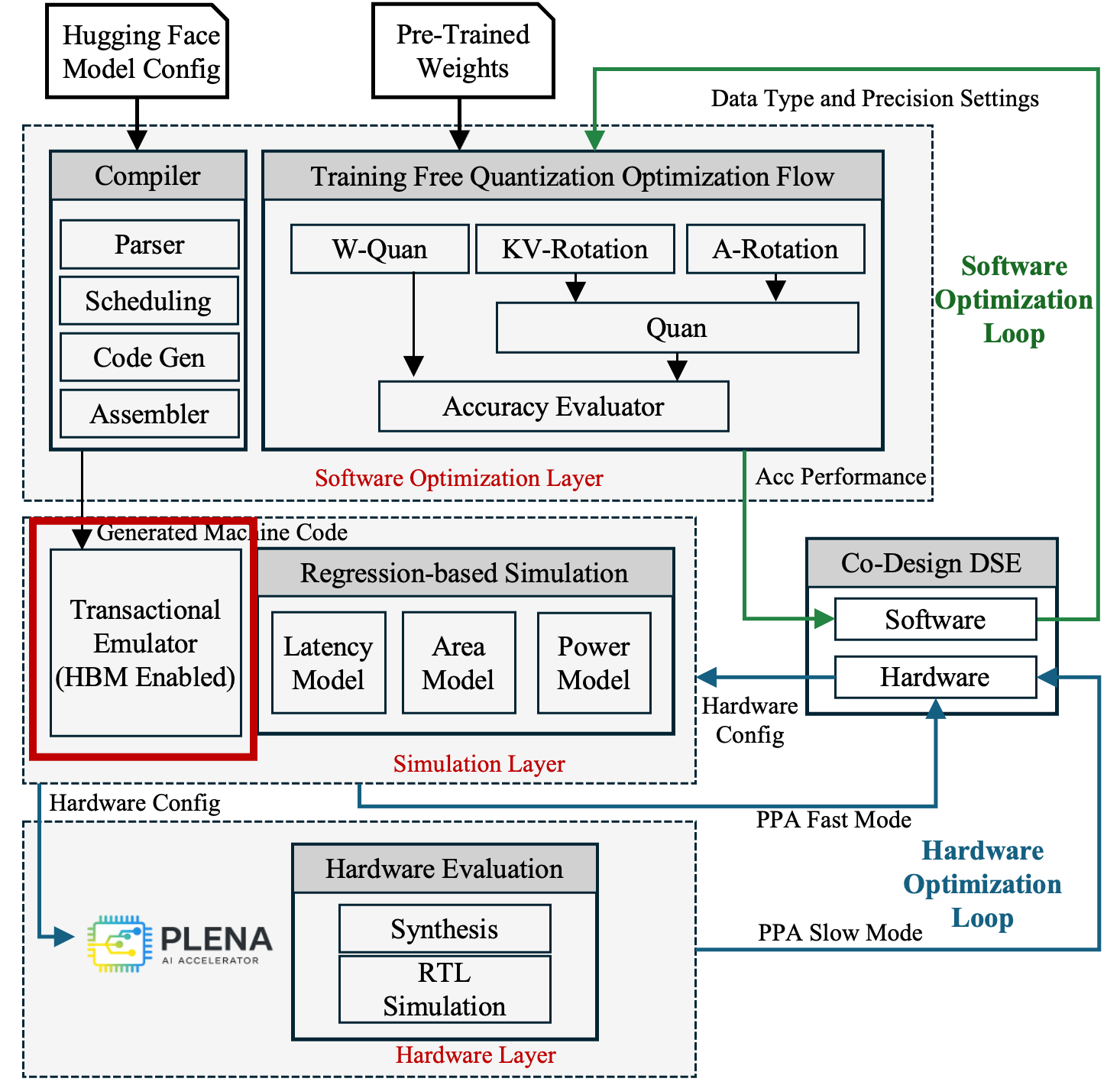
The Transactional Simulator within the PLENA toolchain.
To evaluate architectural trade-offs, we developed a transaction-level (cycle-approximate) emulator in Rust that executes the generated machine code in an event-driven manner. The emulator models compute execution, instruction scheduling, and memory transactions at cycle granularity. It is integrated with Ramulator and DRAMSys to provide detailed off-chip memory timing and bandwidth modeling, including bank-level behavior. This enables quantitative analysis of memory–compute interaction, which is critical because memory bandwidth constitutes a primary bottleneck in long-context LLM inference.
The emulator supports the full PLENA architectural design space, including asymmetric mixed-precision arithmetic. By bridging analytic modeling and RTL simulation, it enables accurate evaluation of architectural mechanisms — such as flattened systolic mapping and on-chip FlashAttention — while remaining significantly faster than RTL simulation. We plan to open-source this emulator to facilitate research on LLM accelerator architectures.
What It Models
- Event-driven execution of the generated PLENA machine code at cycle granularity.
- Compute execution and instruction scheduling across M-type, V-type, S-type, H-type, and C-type instructions.
- On-chip memory transactions against Matrix SRAM, Vector SRAM, Integer SRAM, and FP SRAM, including alignment constraints.
- Off-chip HBM timing and bandwidth via Ramulator / DRAMSys, capturing bank-level behavior for
H_PREFETCH_M,H_PREFETCH_V, andH_STORE_Vtransactions. - Asymmetric mixed-precision arithmetic across weights, activations, and KV cache, matching the full PLENA design space.
- Architectural mechanisms unique to PLENA, including flattened systolic mapping and on-chip FlashAttention.
Positioning
The transactional emulator sits between two other evaluation layers:
- Faster than RTL simulation — cycle-approximate rather than cycle-accurate, so it scales to realistic LLM workloads.
- More accurate than the analytic model — captures memory–compute interaction and bank-level DRAM effects that closed-form cost models cannot represent.
This makes it the right tool for quantitative trade-off studies where memory bandwidth is the dominant bottleneck, as in long-context LLM inference.