Co-Design
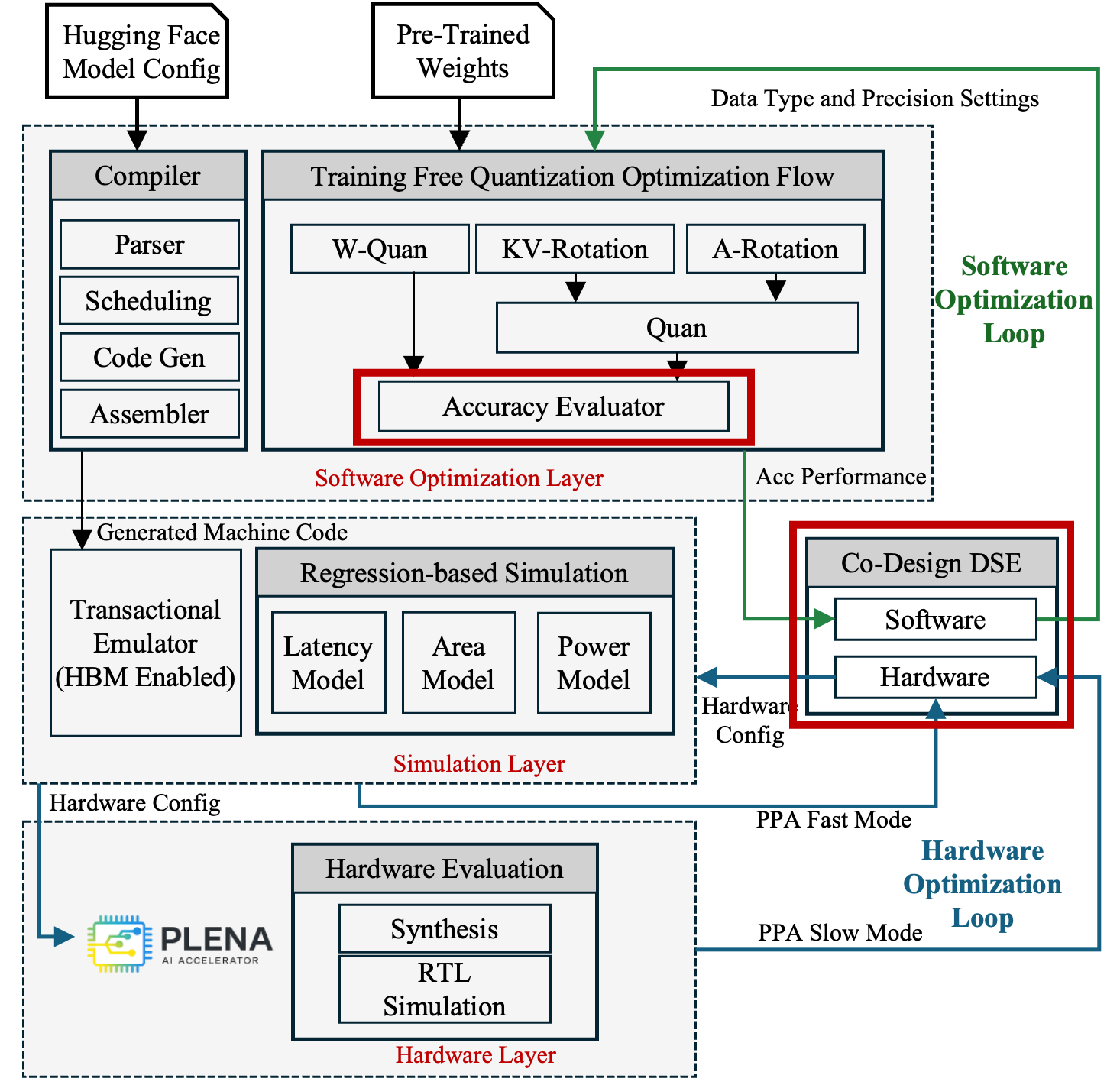
The Co-Design DSE within the PLENA toolchain.
System Co-Design Exploration
The PLENA accelerator's architectural design space spans compute array dimensions, multi-tier memory configurations (3D-stacked SRAM, HBM, and other off-chip technologies), quantization precision, and software strategies — see the Design Space page for the full parameter table. The cross-product of these parameters yields on the order of 10⁶ candidate configurations, making exhaustive search infeasible.
We frame co-design as a multi-objective design space exploration that simultaneously maximizes inference throughput and minimizes power under a total system cost constraint. Each candidate is evaluated by invoking the full Analytic Model stack, and the goal is to approximate the true Pareto frontier within a limited evaluation budget.
Multi-Objective Bayesian Optimization
Because every evaluation is expensive, naive grid or random search is impractical. PLENA uses Multi-Objective Bayesian Optimization (MOBO), which maintains a probabilistic surrogate of each objective and uses it to choose the next configuration to evaluate.
The optimization runs in two phases:
- Initialization.
N_init = 20configurations are drawn via Sobol quasi-random sequences to give broad coverage of the design space, and their objectives are evaluated to seed the dataset. - Iterative phase. Until the budget
N_total = 100is exhausted, the optimizer repeats three steps:- Surrogate fitting — fit independent Gaussian Process (GP) surrogates to the observations, with kernel hyperparameters tuned by maximum likelihood.
- Acquisition maximization — score a random subset of unevaluated configurations with the EHVI acquisition function and pick the highest-scoring candidate.
- Evaluation — evaluate the chosen configuration with the analytic model and add it to the dataset.
By directing evaluations toward regions of high expected improvement, MOBO converges to a high-quality Pareto frontier within a small evaluation budget, exposing favorable throughput–power trade-offs across diverse LLM workloads.
Gaussian Process Surrogate
Each objective is modeled independently with a Gaussian Process, a non-parametric probabilistic model that produces, for any candidate, a predictive mean (the estimated objective value) and a predictive variance (model uncertainty). Variance is higher far from observed points, which naturally balances exploitation of promising regions with exploration of uncertain ones.
Expected Hypervolume Improvement (EHVI)
PLENA adopts Expected Hypervolume Improvement as the acquisition function. Dominated hypervolume is the only unary Pareto-quality indicator that is strictly monotone with respect to Pareto dominance, so maximizing it provably improves the Pareto front.
Given the current Pareto set (\mathcal{P}_t) and a reference point (\mathbf{r}), the dominated hypervolume is:
[ \mathrm{HV}(\mathcal{P}_t, \mathbf{r}) = \mathrm{Vol}\bigl({\mathbf{y} \in \mathbb{R}^M \mid \exists\, \mathbf{x} \in \mathcal{P}_t : \mathbf{f}(\mathbf{x}) \preceq \mathbf{y} \preceq \mathbf{r}}\bigr). ]
EHVI is the expected increase in this hypervolume if candidate (\mathbf{x}) were evaluated, integrating over the GP posterior:
[ \alpha_{\mathrm{EHVI}}(\mathbf{x}) = \mathbb{E}\bigl[\mathrm{HV}(\mathcal{P}_t \cup {\mathbf{x}}, \mathbf{r}) - \mathrm{HV}(\mathcal{P}_t, \mathbf{r}) \mid \mathcal{D}_t\bigr]. ]